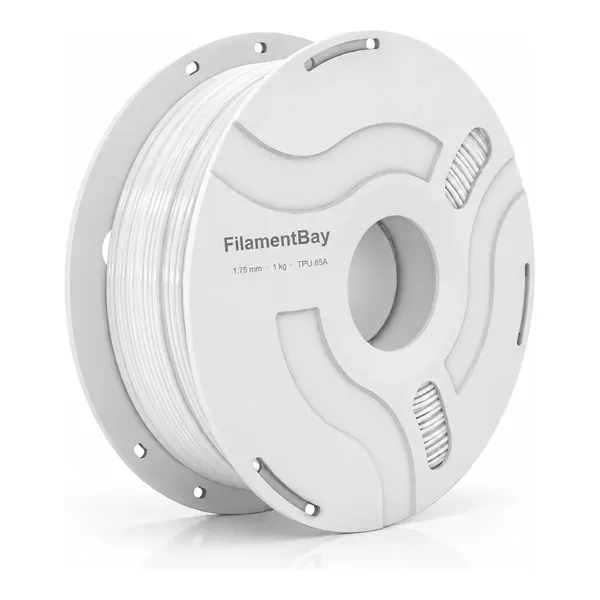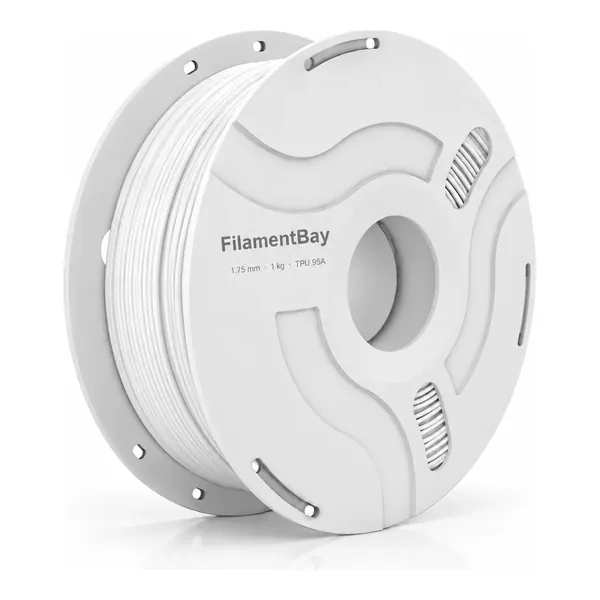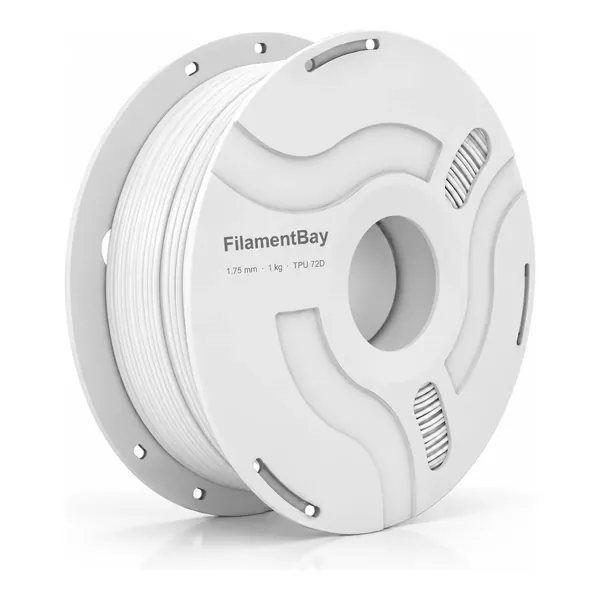
Illustrative imagery; not a record of a material validation test.
TPU hardness explained: 85A vs 90A vs 95A vs 98A vs 72D
- Compare 85A–98A within Shore A; 72D uses a different scale. Hardness alone does not predict part stiffness or lifespan.
- Use thickness, walls and infill as design variables before buying a harder grade.
- 85A–98A: external spool. 72D: AMS lite only under the documented hardness guidance; full-size AMS uses external feeding.
Hardness describes the material; geometry defines the part
Shore hardness is resistance to indentation. The A and D scales use different test conditions, so do not subtract 72D from 95A or convert them with a simple ratio. Within our A grades, increasing the number means a harder nominal material.
A thin wall in a harder grade can bend more easily than a thick wall in a softer grade. Supplier brochure tensile and elongation numbers describe material specimens; they do not promise the same result across FDM layers. Use the evidence register before designing to a number.
Choose a candidate, then make a sample
These are starting candidates for a fit-and-flex trial, not tested end-use approvals. Direct drive reduces the unsupported path but does not guarantee feeding.
| Grade | Trial application | Feed-path starting point | Bambu feeder |
|---|---|---|---|
| 85A | Soft contact pad | Direct drive recommended | External spool |
| 90A | Flexible grip | Direct drive recommended | External spool |
| 95A | Case or bumper | Direct drive; trial Bowden cautiously | External spool |
| 98A | Firmer flexing part | Check extruder support and friction | External spool |
| 72D | Firm protective shell | Check extruder and temperature limits | AMS lite only; external on full-size AMS |
Run a comparable bend trial
Print the same strip in two candidate grades using the same orientation, layer height, walls and infill. Record dimensions, spool batch, conditioning, slicer version and whether either sample has voids. Reject visibly defective samples before comparing feel.
Use a repeatable fixture with a fixed span and a displacement relevant to the part. Record the force, recovery after unloading and any permanent set. Repeat on several samples. Do not interpret this workshop screen as a standardized hardness, fatigue or medical test.
Hypothetical design example: compare a 2 mm and 3 mm wall in the same grade before changing material. Label the thicker sample explicitly; a change in bending response would not prove that its resin is harder. No physical results for this example have been collected.
Decide what to change next
If feeding fails, resolve drag, buckling and flow before rejecting the grade for part performance. If feeding is stable but the part is too stiff, change one geometry variable or sample a softer grade. If it takes a permanent set, reduce strain or evaluate a different design.
Write acceptance criteria before testing: required fit, allowable deflection, recovery interval and inspection after repeated use. For seals, skin contact or load-bearing parts, obtain application-specific evidence; a comfortable prototype is not qualification.
Sources and limits
- FilamentBay evidence and editorial policy — Supplier brochure values, missing test conditions and how to submit corrections; not certification of printed parts. Reviewed 2026-09-08.
- Prusa: Flexible materials — General feed-path, retraction and surface guidance; Prusa settings are not validated FilamentBay profiles. Reviewed 2026-09-08.
- Bambu Lab: AMS lite FAQ — AMS lite hardness and spool limits; retained from the official-page browser verification recorded on 2026-09-08. Does not establish full-size AMS compatibility or a FilamentBay feed test. Reviewed 2026-09-08.
Compare all 20 grades · Profile validation status · Evidence register
Revision record
: Replaced object analogies and blanket AMS claims with a grade matrix, controlled sample method and explicit evidence limits.
First published 2026-09-06. To flag an error, contact the FilamentBay team with the guide URL, disputed statement and supporting source. We review the evidence and record substantive corrections here.