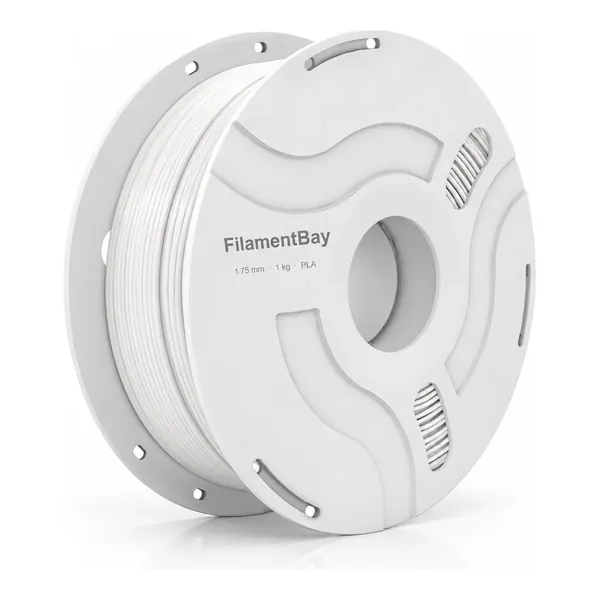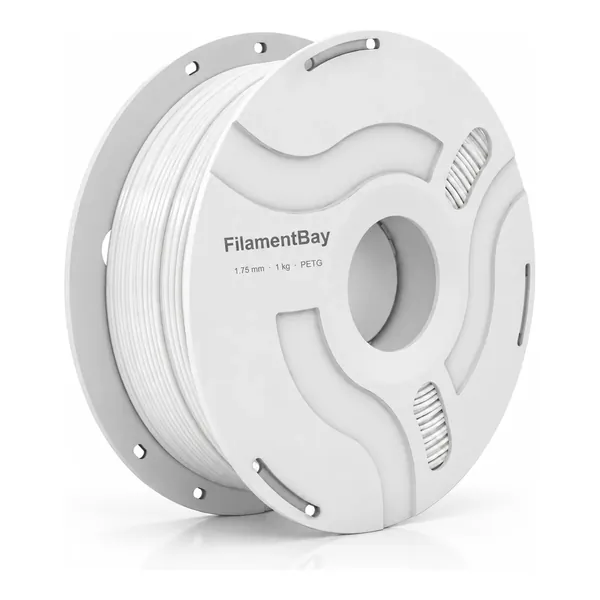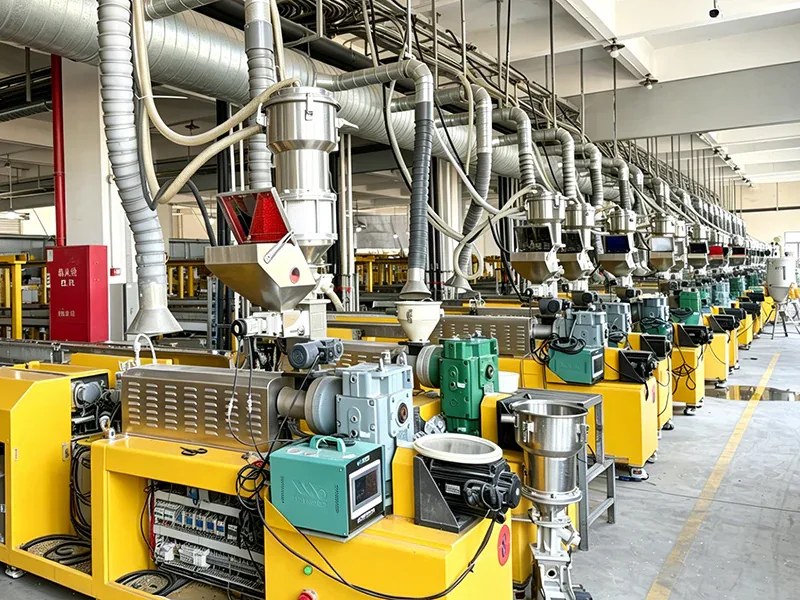
Illustrative imagery; not a record of a material validation test.
What filament really costs a print farm, per kg and per part
- Forecast from actual sliced mass and accepted output where possible. A peak flow setting is not average monthly consumption.
- Compare total cost per accepted part, including rejects, machine time, labor and freight.
- Bulk prices and lead times require a current quote; examples below are hypothetical.
Estimate consumption with explicit units
For a steady extrusion estimate: kg = printer count × operating hours/day × days × average flow in mm³/s × 3600 × density in g/cm³ ÷ 1,000,000. The divisor converts mm³ to cm³ and grams to kilograms.
Hypothetical calculation: one printer × 16 hours × 30 days × 12 mm³/s × 3600 × 1.23 ÷ 1,000,000 = 25.505 kg/month. This assumes extrusion at 12 mm³/s throughout every counted hour. Travel, heating and idle time make a peak-flow estimate overstate use. At an illustrative 50% extrusion duty fraction, this becomes 12.753 kg.
For purchasing, sum slicer mass for the actual job queue, add measured purge/support/reject usage and reconcile it with spool weights. Do not add a duty factor again when using measured average flow or actual consumed mass.
Build a cost per accepted part
Cost per accepted part = total material, machine, energy, labor, inspection and allocated freight cost divided by accepted parts. Keep attempted and accepted quantities separate. Include reprints once, and avoid counting electricity twice if your machine rate already includes it.
| Input | What to record | Common mistake |
|---|---|---|
| Material | Net kg consumed × landed $/kg | Ignoring supports, purge and remnants |
| Machine | Actual occupied hours × defined hourly rate | Counting only successful runs |
| Labor | Setup, removal, rework and packing time | Assuming the operator is free |
| Quality | Accepted quantity and rejection reason | Mixing cosmetic seconds with accepted output |
| Freight | Shipment costs allocated consistently | Treating quoted unit price as landed cost |
Hypothetical batch example
Suppose 100 attempts use 5 kg at $20/kg, 80 machine hours at $0.50/hour, and $30 labor. Total modeled cost is $100 + $40 + $30 = $170, before any omitted freight or other costs. If 90 parts pass, cost is $170 / 90 = $1.89 per accepted part.
A lower $18/kg price saves $10 on that batch, reducing the same modeled cost to $1.78 per accepted part. If process changes instead produce 95 accepted parts at the original $170 cost, the result is $1.79. These examples isolate variables; no FilamentBay savings or acceptance rates are being claimed.
Qualify a new spool or batch before scaling
Use a representative production part with known inspection criteria. Record spool batch/color, profile, dimensions, surface defects, completed time and accepted count. Compare against a retained baseline under equivalent conditions.
Start with a small planned trial, then expand only if the results meet your criteria. Published nominal diameter tolerance does not replace batch measurement or prove lower failure rates. Request available lot documentation and note missing evidence before placing recurring orders.
Ask for a quote you can compare
Provide monthly volume, material/color mix, spool size, destination, target date and sample/inspection requirements. Ask whether the quote includes freight, packaging, tax, validity period and pre-order items. Confirm any discount and stock before payment.
Use the print-farm calculator as a scenario tool and the wholesale workflow for commercial confirmation. Neither a modeled saving nor a submitted inquiry establishes a price, delivery date or payment obligation.
Sources and limits
- FilamentBay evidence and editorial policy — Supplier brochure values, missing test conditions and how to submit corrections; not certification of printed parts. Reviewed 2026-09-08.
- FilamentBay wholesale workflow — Current inquiry process; quoted terms must be confirmed for the order. Reviewed 2026-09-08.
Compare all 20 grades · Profile validation status · Evidence register
Revision record
: Corrected the monthly-use inconsistency; added dimensional arithmetic, duty-cycle limits and a full accepted-part cost example.
First published 2026-09-06. To flag an error, contact the FilamentBay team with the guide URL, disputed statement and supporting source. We review the evidence and record substantive corrections here.