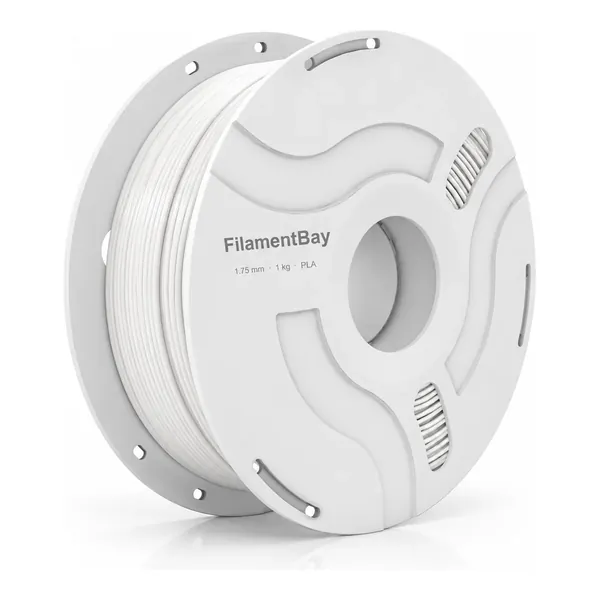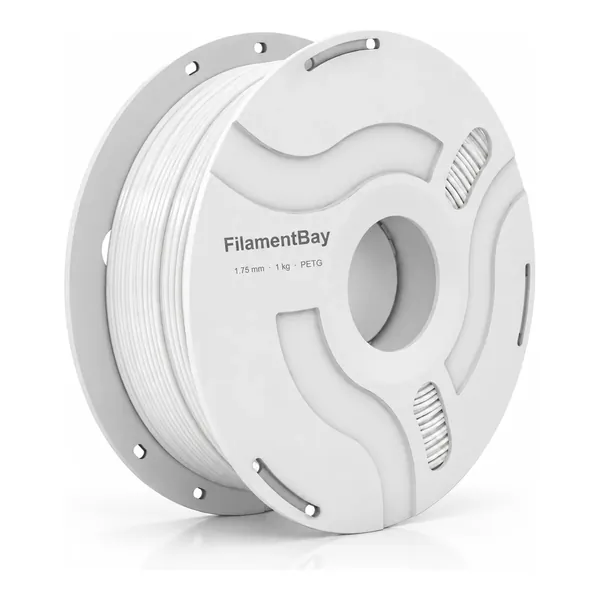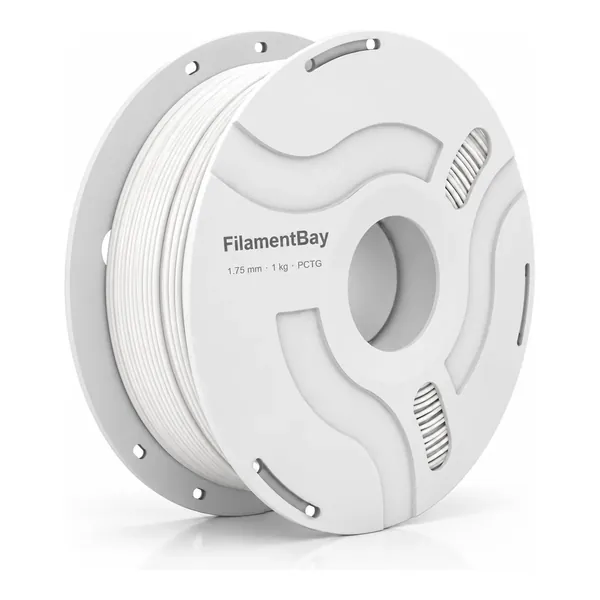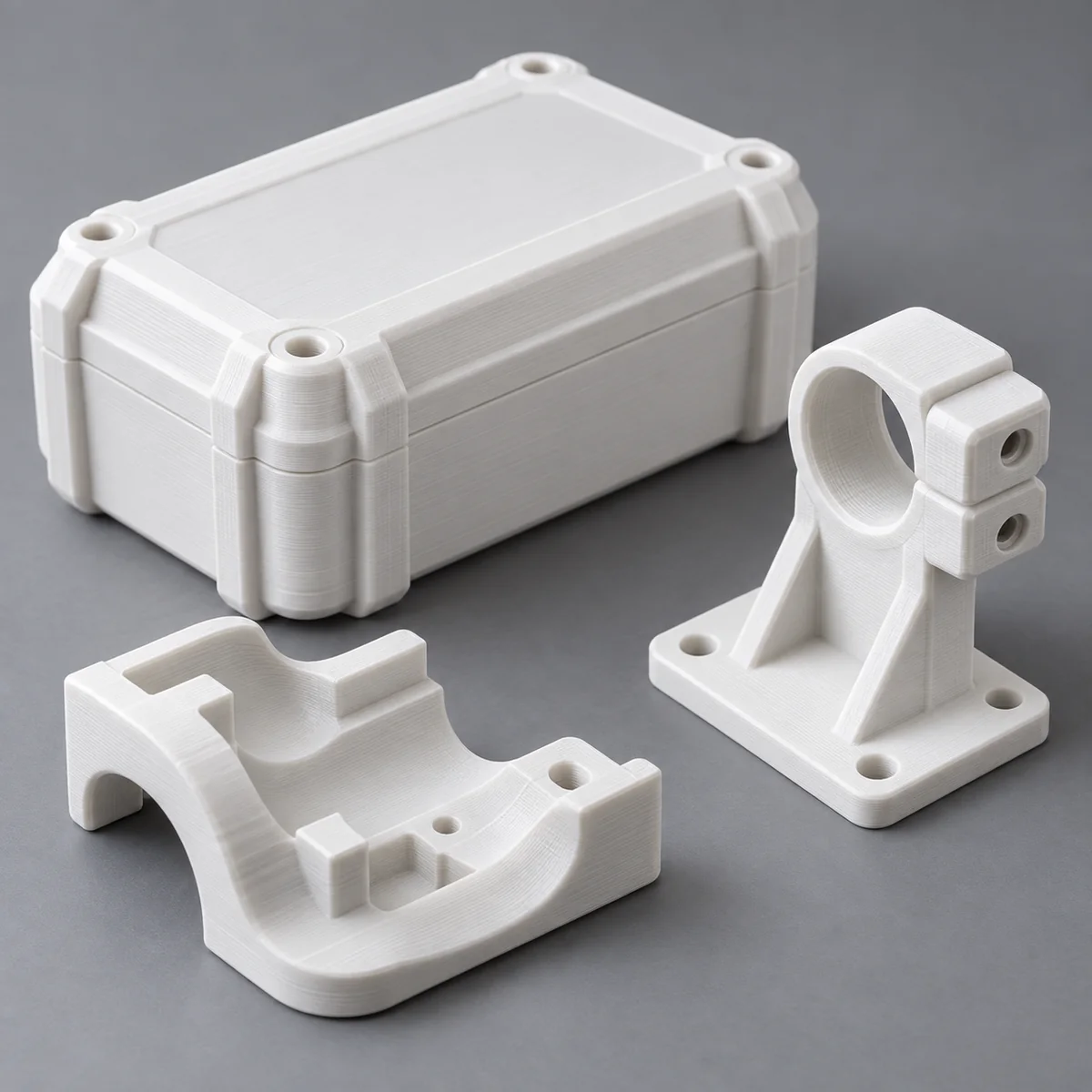
Illustrative imagery; not a record of a material validation test.
PLA vs PETG vs PCTG: which one for the part in front of you
- Choose by the actual environment and failure mode, then test the printed design.
- Our published PLA and PLA+ mechanical values are the same; they do not demonstrate a PLA+ strength advantage.
- Catalog impact and HDT numbers are supplier values, not proof of printed-part strength, safe use temperature or food-contact suitability.
What the available numbers can support
The catalog reproduces supplier brochure typical values. We do not have a public same-day comparison of printed specimens for these four materials. Test conditions and printed orientation matter; do not rank finished parts by a single resin number.
| Material | Tensile MPa | Impact kJ/m² | HDT °C | Decision limit |
|---|---|---|---|---|
| PLA | 40 ± 6 | 5 ± 3 | 55 ± 5 | Baseline; qualify actual temperature/load |
| PLA+ | 40 ± 6 | 5 ± 3 | 55 ± 5 | No demonstrated advantage in these values |
| PETG | 48 ± 10 | 3 ± 1 | 70 ± 5 | Higher listed tensile does not mean higher impact |
| PCTG | 50 ± 3 | 25 ± 5 | 101 ± 2 | Listed impact advantage needs printed validation |
Choose by environment before appearance
For an indoor display part, compare finish, ease of printing and accepted-part cost. For a clip, test repeated flex and recovery. For a bracket, evaluate layer direction, sustained load and temperature together. For sunlight or chemical exposure, request evidence for that grade and actual conditions.
HDT is a measurement under a specified method and load, not a continuous operating rating. Do not select a hot-car part merely because a brochure HDT exceeds an estimated air temperature. Dark surfaces, stress concentrations and creep can change the outcome.
A fair PLA / PLA+ / PETG / PCTG trial
Keep the design and required function constant, but use an appropriate calibrated process for each material. Record all process differences rather than forcing one nozzle temperature on all four. Test both the weakest expected orientation and the intended production orientation.
Define acceptance before comparing: dimensions after cooling, assembly fit, load duration, displacement and visible cracks. Repeat on multiple samples, note spread and retain a control. This is a proposed screening method; we have no measured results to publish for it.
Hypothetical accepted-part cost
If a part uses 40 g including support, material at $20/kg costs $0.80 per attempt. At a hypothetical 90% acceptance rate, material cost per accepted part is $0.80 / 0.90 = about $0.89. A $24/kg alternative at 98% acceptance costs $0.96 / 0.98 = about $0.98. Neither acceptance rate is measured here.
Add machine hours, labor, energy and inspection before choosing. A cheaper spool or higher impact number alone cannot identify the lower-cost production process.
Food contact requires separate evidence
We do not recommend these FilamentBay printed parts for food contact on the evidence currently available. BPA-free resin language does not establish the suitability of a finished object, its pigments, additives or printing process.
FDA describes assessment in relation to intended use and migration/exposure. Request documentation applicable to the exact material and contact conditions; dry goods or hand washing is not a substitute for that assessment.
Sources and limits
- FilamentBay evidence and editorial policy — Supplier brochure values, missing test conditions and how to submit corrections; not certification of printed parts. Reviewed 2026-09-08.
- Prusa: Material guide — General material selection context; quantitative FilamentBay properties come from the catalog and evidence register. Reviewed 2026-09-08.
- FDA: Food contact substances — information for consumers — Food-contact assessment depends on intended use and migration/exposure; this source does not approve FilamentBay filament or printed objects. Reviewed 2026-09-08.
Compare all 20 grades · Profile validation status · Evidence register
Revision record
: Removed unsupported same-day testing and food-contact advice; added decision boundaries, a sample protocol and cost arithmetic.
First published 2026-09-06. To flag an error, contact the FilamentBay team with the guide URL, disputed statement and supporting source. We review the evidence and record substantive corrections here.